Mrs Lorber's Homepage
  • Home Page
    • About Mrs. Lorber >
      • Mrs Lorber's Mission Statement
    • Blogging Rules >
      • PM Class Blog: Let's Talk...
  • Reading Workshop
    • What's Happening This Week
    • Georgia Common Core Reading Standards
    • Literacy Work Stations
    • Fourth Grade Reading Literary RL >
      • ELAGSE4RL1 Explicit / Inferential Details and Examples In The Text
      • ELAGSE4RL2 Determine Theme; Summarize >
        • Summarize
      • ELAGSE4RL3 Describe Character, Setting, Events with Specific Details
      • ELAGSE4RL4 Meaning of Words and Phrases
      • ELAGSE4RL5 Differences and Structural Elements of Poems, Drama, and Prose
      • ELAGSE4RL6 Point of View >
        • Author's Purpose
      • ELAGSE4RL7 Making Connections Between Text and Visual or Oral Presentations >
        • ELAGSE4RL10 Range of Reading
      • ELAGSE4RL9 Compare and Contrast Themes, Topics and Patterns in Literature >
        • More
    • Fourth Grade Reading Informational RI >
      • ELAGSE4RI1 Refer to Details and Examples in Text Explicit and Inferences
      • ELAGSE4RI2 Main Idea, Details, Summarize
      • ELAGSE4RI3 Historical, Scientific and Technical Text
      • ELAGSE4RI4 Academic Language
      • ELAGSE4RI5 Text Structure
      • ELAGSE4RI6 Firsthand and Secondhand Accounts of the Same Topic
      • ELAGSE4RI7 Text Features
      • ELAGSE4RI8 Reasons and Evidence to Support Points in a Text
      • ELAGSE4RI9 Integrate Information from 2 Texts on the Same Topic
  • Reading Strategies
    • Homeroom Class Blog: Let's Talk...
    • Genres
    • How to Find a Just Right Book
    • How To Answer Open-Ended Questions >
      • Fountas and Pinnell Reading Chart
    • QAR Question - Answer Relationship
    • For Constructed Response Questions Use R.A.C.E.
  • Language Arts/Spelling
    • Georgia Standards of Excellence ELA Standards
    • Grammar >
      • Whats Happening This Week in Grammar!
      • Nouns >
        • Common and Proper Nouns
        • Singular and Plural Nouns
        • Possessive Nouns
      • Verbs >
        • Verb Tenses
        • State of Being Verbs
        • Progressive Verbs
        • Modal Auxillaries
      • Pronouns >
        • Relative Pronouns
      • Prepositions >
        • Prepositional Phrases
      • Adjectives >
        • Adjective Order
      • Adverbs >
        • Relative Adverbs
      • Sentences >
        • Subjects and Predicates
      • Clauses >
        • Conjunctions
    • Words Their Way >
      • What's Happening This Week!
  • Vocabulary
    • Multiple Meaning Words
    • Context Clues
    • Roots and Affixes (Prefixes and Suffixes) >
      • Greek and Latin Prefixes, Suffixes, and Roots
    • Figurative Language >
      • Similies and Metaphors
      • Idioms, Adages and Proverbs
      • Synonyms and Antonyms
  • Writing Workshop
    • Common Core Writing Standards
    • What's Happening this Week in Class!
    • Narrative Writing
    • Opinion Writing
    • Information Let's Write a Book
    • Transitions Words
    • Capitalization
    • Quotation Marks
    • Punctuation
    • Word Choice >
      • Homework
  • Social Studies Webquests
    • American Revolution
    • New Nation
    • Westward Expansion
    • Part 2 Westward Expansion 1824-1850
    • Industrial Revolution 1790-1837
    • Immigrants and Reformers 1840-1848
    • Civil War >
      • Battles of the Civil War
    • Reconstruction
  • Technology Resources
  • Schedule
    • Assignment Notebook: The Agenda
  • Wilson Creek CATS LAB
  • Scholastic
  • Georgia Milestones

Relative Adverbs

Picture
Adverbs are words that describe or give information about adjectives, verbs, and other adverbs.
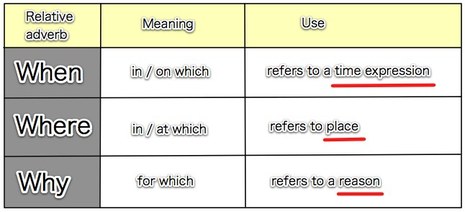
 The relative adverbs are where, when, and why are used at the beginning of a relative clause. A relative clause is used to tell more about a noun.


In the following examples, the relative adverbs are underlined.
Examples of relative  adverbs:

* Where: refers to a place
I don’t know where we are going for dinner.

*  When: refers to a time
I remember the day when I started school.

*  Why: refers to a reason
“Do you know why George cannot go to the movies with us?”


http://www.learnenglishfeelgood.com/elt-relative-adverbs1.html
4_l_1a_using_relative_adverbs14.ppt
File Size: 1087 kb
File Type: ppt
Download File

Powered by Create your own unique website with customizable templates.
