ELAGSE4RI6: Compare and contrast a firsthand and secondhand account of the same event or topic; describe the differences in focus and the information provided. GSE
Firsthand and Secondhand accounts, do you know the difference?
A firsthand account (retelling) is one in which you are directly involved; you have personal experience.This is a description or explanation of an event, told by a person who witnessed or was a part of the event.
A secondhand account is a description or explanation of an event, told by someone who knows
of the event but was not actually there, you do not have direct experiemce; the information you have obtained is from a variety of sources.
http://www.learningfarm.com/web/practicePassThrough.cfm?TopicID=157
http://www.google.com/url?sa=t&rct=j&q=&esrc=s&frm=1&source=web&cd=5&ved=0CEQQFjAE&url=http%3A%2F%2Fwww.vrml.k12.la.us%2F4th%2Fss%2Fprimary_2nddocuments%2Felem%2Fprimary_2nd_docs.ppt&ei=dhGdUv_rDY3IkAfS9YHADg&usg=AFQjCNEGwPFEBVtsfYPIZLY6lWlNIo5hHg
Take a look for further information:
https://www.youtube.com/watch?v=Oe8JlmBomF0
https://www.youtube.com/watch?v=nASFmtquU5I stop at 40 seconds
https://www.youtube.com/watch?v=o5THVDRJsM4&t=12s
https://www.youtube.com/watch?v=cqXHO7bTPnw
https://www.youtube.com/watch?v=Wlj7t0s4rok
A secondhand account is a description or explanation of an event, told by someone who knows
of the event but was not actually there, you do not have direct experiemce; the information you have obtained is from a variety of sources.
http://www.learningfarm.com/web/practicePassThrough.cfm?TopicID=157
http://www.google.com/url?sa=t&rct=j&q=&esrc=s&frm=1&source=web&cd=5&ved=0CEQQFjAE&url=http%3A%2F%2Fwww.vrml.k12.la.us%2F4th%2Fss%2Fprimary_2nddocuments%2Felem%2Fprimary_2nd_docs.ppt&ei=dhGdUv_rDY3IkAfS9YHADg&usg=AFQjCNEGwPFEBVtsfYPIZLY6lWlNIo5hHg
Take a look for further information:
https://www.youtube.com/watch?v=Oe8JlmBomF0
https://www.youtube.com/watch?v=nASFmtquU5I stop at 40 seconds
https://www.youtube.com/watch?v=o5THVDRJsM4&t=12s
https://www.youtube.com/watch?v=cqXHO7bTPnw
https://www.youtube.com/watch?v=Wlj7t0s4rok
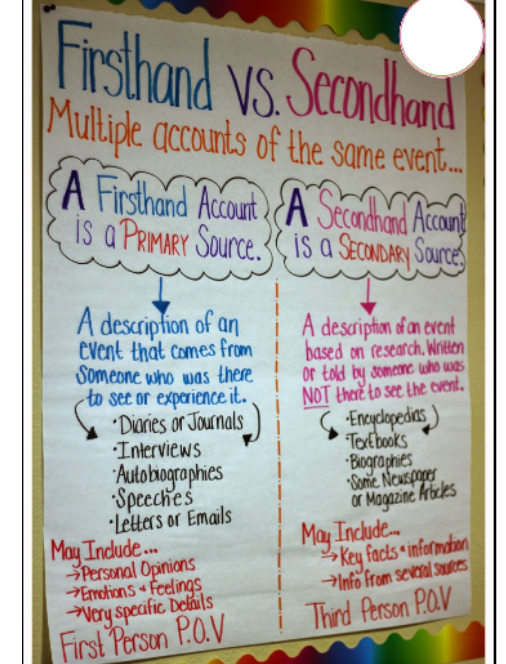
Different authors often write about the same event or idea differently. When you read two different accounts or descriptions of the same subject, you can learn different things. This way, you can compare and contrast the authors’ points, or their ideas and information, on the subject.
Firsthand account
In a firsthand account, the person writing a text is a part of the events. The passage is written using words like “I” and “we.” The author may include his or her feelings and thoughts on the subject.
Secondhand account
In a secondhand account, the person writing a text is not a part of the events. The events the author describes have happened to someone else. The author mostly includes information and facts on the subject.
When comparing and contrasting two passages, look for:
Firsthand account
In a firsthand account, the person writing a text is a part of the events. The passage is written using words like “I” and “we.” The author may include his or her feelings and thoughts on the subject.
Secondhand account
In a secondhand account, the person writing a text is not a part of the events. The events the author describes have happened to someone else. The author mostly includes information and facts on the subject.
When comparing and contrasting two passages, look for:
- The most important point in each text
- The most important details in each text
- The ideas only found in one text and not in another
- Whether a text has more facts and details or feelings and thoughts
- Whether a text uses the pronouns “I” or “we
