Mrs Lorber's Homepage
  • Home Page
    • About Mrs. Lorber >
      • Mrs Lorber's Mission Statement
    • Blogging Rules >
      • PM Class Blog: Let's Talk...
  • Reading Workshop
    • What's Happening This Week
    • Georgia Common Core Reading Standards
    • Literacy Work Stations
    • Fourth Grade Reading Literary RL >
      • ELAGSE4RL1 Explicit / Inferential Details and Examples In The Text
      • ELAGSE4RL2 Determine Theme; Summarize >
        • Summarize
      • ELAGSE4RL3 Describe Character, Setting, Events with Specific Details
      • ELAGSE4RL4 Meaning of Words and Phrases
      • ELAGSE4RL5 Differences and Structural Elements of Poems, Drama, and Prose
      • ELAGSE4RL6 Point of View >
        • Author's Purpose
      • ELAGSE4RL7 Making Connections Between Text and Visual or Oral Presentations >
        • ELAGSE4RL10 Range of Reading
      • ELAGSE4RL9 Compare and Contrast Themes, Topics and Patterns in Literature >
        • More
    • Fourth Grade Reading Informational RI >
      • ELAGSE4RI1 Refer to Details and Examples in Text Explicit and Inferences
      • ELAGSE4RI2 Main Idea, Details, Summarize
      • ELAGSE4RI3 Historical, Scientific and Technical Text
      • ELAGSE4RI4 Academic Language
      • ELAGSE4RI5 Text Structure
      • ELAGSE4RI6 Firsthand and Secondhand Accounts of the Same Topic
      • ELAGSE4RI7 Text Features
      • ELAGSE4RI8 Reasons and Evidence to Support Points in a Text
      • ELAGSE4RI9 Integrate Information from 2 Texts on the Same Topic
  • Reading Strategies
    • Homeroom Class Blog: Let's Talk...
    • Genres
    • How to Find a Just Right Book
    • How To Answer Open-Ended Questions >
      • Fountas and Pinnell Reading Chart
    • QAR Question - Answer Relationship
    • For Constructed Response Questions Use R.A.C.E.
  • Language Arts/Spelling
    • Georgia Standards of Excellence ELA Standards
    • Grammar >
      • Whats Happening This Week in Grammar!
      • Nouns >
        • Common and Proper Nouns
        • Singular and Plural Nouns
        • Possessive Nouns
      • Verbs >
        • Verb Tenses
        • State of Being Verbs
        • Progressive Verbs
        • Modal Auxillaries
      • Pronouns >
        • Relative Pronouns
      • Prepositions >
        • Prepositional Phrases
      • Adjectives >
        • Adjective Order
      • Adverbs >
        • Relative Adverbs
      • Sentences >
        • Subjects and Predicates
      • Clauses >
        • Conjunctions
    • Words Their Way >
      • What's Happening This Week!
  • Vocabulary
    • Multiple Meaning Words
    • Context Clues
    • Roots and Affixes (Prefixes and Suffixes) >
      • Greek and Latin Prefixes, Suffixes, and Roots
    • Figurative Language >
      • Similies and Metaphors
      • Idioms, Adages and Proverbs
      • Synonyms and Antonyms
  • Writing Workshop
    • Common Core Writing Standards
    • What's Happening this Week in Class!
    • Narrative Writing
    • Opinion Writing
    • Information Let's Write a Book
    • Transitions Words
    • Capitalization
    • Quotation Marks
    • Punctuation
    • Word Choice >
      • Homework
  • Social Studies Webquests
    • American Revolution
    • New Nation
    • Westward Expansion
    • Part 2 Westward Expansion 1824-1850
    • Industrial Revolution 1790-1837
    • Immigrants and Reformers 1840-1848
    • Civil War >
      • Battles of the Civil War
    • Reconstruction
  • Technology Resources
  • Schedule
    • Assignment Notebook: The Agenda
  • Wilson Creek CATS LAB
  • Scholastic
  • Georgia Milestones
Picture
Picture
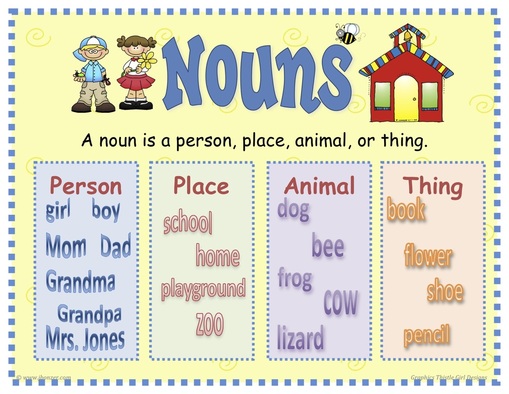
~Nouns
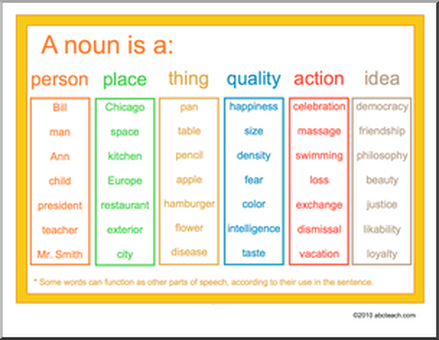
A noun names a person, a place, a thing, or an idea. For example:
  • Person (Jacob, girl, teacher, Mrs. Lorber)
  • Place (Georgia, school, Atlanta)
  • Thing (computer, tree, elephant)
  • Idea (happiness, anger, responsibility)
http://www.youtube.com/watch?feature=player_embedded&v=Sy72OPgdVuA

Practice Finding Nouns:
http://english-zone.com/grammar/find-a-noun1.html

http://www.abcya.com/nouns_and_verbs.htm
http://www.sheppardsoftware.com/grammar/nouns.htm
http://www.testprepreview.com/modules/nouns.htm
http://www.harcourtschool.com/activity/basketball/
http://www.eduplace.com/cgi-bin/hme-quiz-start.cgi?Grade=4&Unit=2&Topic=Nouns&x=37&y=8
http://www.harcourtschool.com/activity/language_arts/goforgold/content_builder/dswmedia/g4c2/nadia.htm
Concrete and Abstract Nouns
A concrete noun names something you can see, touch, taste, hear, or smell
An abstract noun names an idea, feeling, emotion or quality
Examples:
Concrete: lion, table,The White House
Abstract: fear, kindness, beauty 

Collective Nouns:
A collective noun is a noun that is singular in form but names a group of people, animals and things
Examples:
People: crew, audience, class, committee
Animals: herd, flock, litter, swarm
Things: collection, bundle, set 

(Parts of Speech 1) Nouns from Effortless English Ltd.
Powered by Create your own unique website with customizable templates.